Will Tennessee Ever Legalize Weed or Are We Stuck in the Mud
Is Tennessee Legalizing Weed in 2026? Here's the Quick Answer

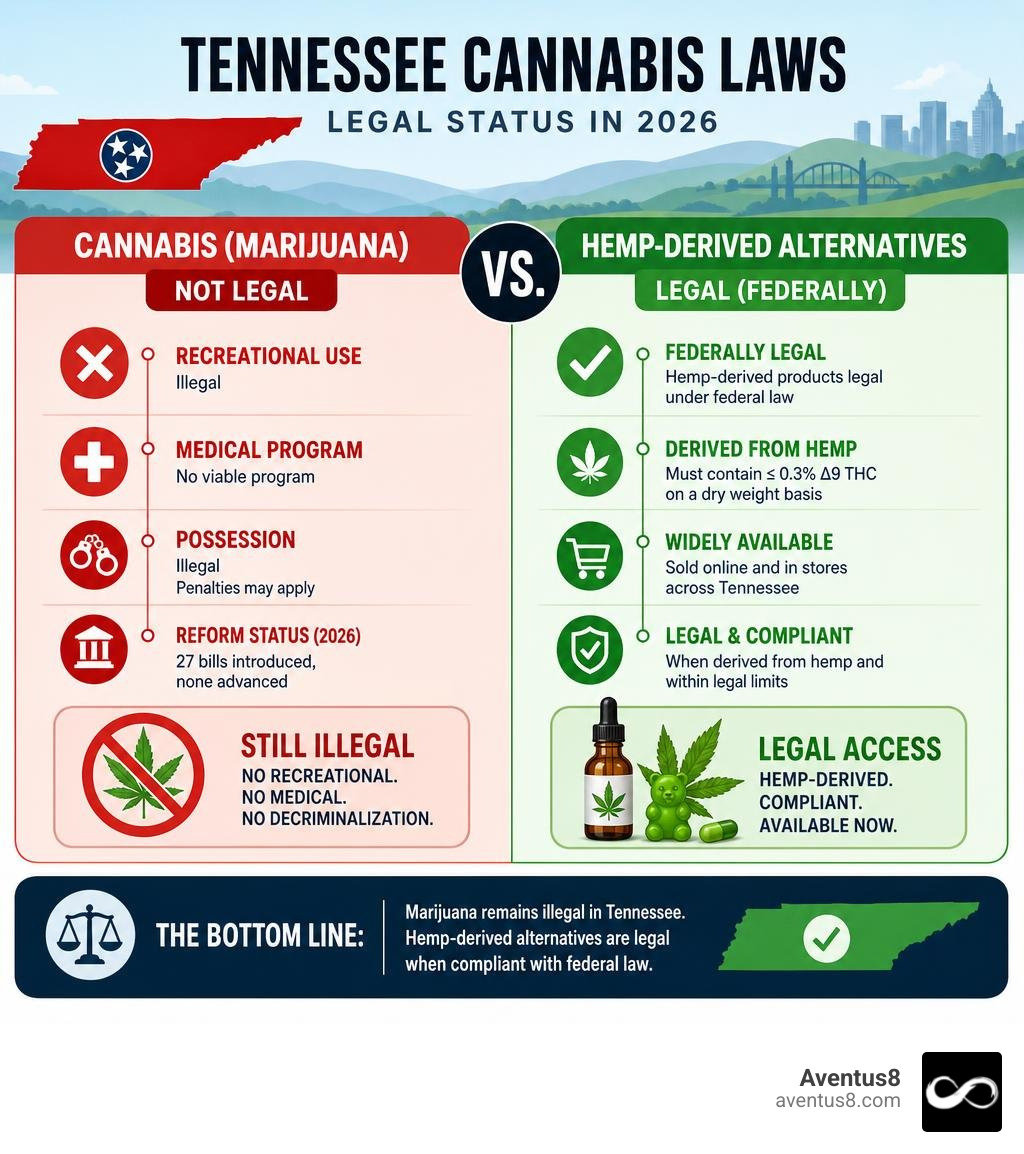
Is Tennessee legalizing weed in 2026? No — not yet, and not anytime soon based on the current legislative trajectory.
Here is where things stand right now:
| Question | Answer |
|---|---|
| Recreational marijuana legal? | No |
| Medical marijuana program? | No viable program |
| Decriminalization? | No |
| CBD oil (low-THC) access? | Limited — requires a physician |
| THCA products still available? | No — banned as of January 1, 2026 |
| Any reform bills passed in 2026? | No — 27 bills introduced, none advanced |
Tennessee remains one of only nine states with no viable medical cannabis program. In 2025 alone, 11,117 people were arrested for cannabis possession in the state. Meanwhile, 81% of Tennessee voters say they support letting patients and doctors decide on medical cannabis — yet the legislature keeps stalling.
The gap between public opinion and actual law is striking. And for residents or visitors from places like Hollywood, FL — where a full medical program exists, dispensaries are a normal part of the local landscape, and adult-use cannabis has been a major topic of local progress — Tennessee's approach can feel like a different world entirely.
This article breaks down exactly where Tennessee stands, what has blocked reform, and what options exist for health-conscious consumers who want legal, accessible cannabinoid products right now.
I'm Max Shemesh, founder and CEO of Aventus8, a hemp industry company based in Hollywood, FL — and I've spent years tracking the patchwork of state laws around is Tennessee legalizing weed and how they affect access to legal hemp-derived products. From our base in Hollywood, FL, we help consumers nationwide find compliant, high-quality cannabinoid solutions regardless of where their state's cannabis laws currently stand.
The Current Legal Landscape: Is Tennessee Legalizing Weed in 2026?
When you look at a Where marijuana is legal in the United States map, Tennessee stands out like a sore thumb in the Southeast. While neighboring states have slowly built out medical programs, the Volunteer State remains a strict prohibition state. Recreational marijuana is entirely illegal, and the state has some of the most punitive laws in the country for simple possession.
For those of us observing from our sunny headquarters in Hollywood, FL, where medical dispensaries are a normal part of the local landscape and cannabis conversations are highly progressive, the situation in Tennessee feels incredibly restrictive.
The Reality of Cannabis Laws in Tennessee vs. Hollywood, FL
In Tennessee, there is no broad medical marijuana program. The state has a highly restrictive "low-THC" program that allows patients with severe, intractable epilepsy to use CBD oil containing up to 0.9% THC. However, there is a major catch: the law does not provide a legal mechanism to acquire or cultivate this oil within state borders. Patients must legally purchase it out of state and transport it back, putting them in a precarious legal gray area.
Compare this to our home base in Hollywood, FL. Here in Broward County, Florida’s medical marijuana program is robust and highly accessible. Patients with qualifying conditions can easily consult a physician, obtain their medical card, and visit any number of state-licensed dispensaries right here in Hollywood, FL, or have products delivered straight to their doors. The contrast couldn't be sharper. While we enjoy a flourishing, regulated cannabis culture in Florida, our friends in Tennessee are left with almost zero legal avenues.
Why Is Tennessee Legalizing Weed Such a Slow Process?
According to the Tennessee MPP, the lack of progress comes down to a deeply conservative supermajority in the state legislature that has repeatedly blocked any form of cannabis reform.
Over the years, dozens of bills aiming to decriminalize possession, establish a compassionate medical program, or study the economic benefits of legalization have been introduced. Yet, almost all of them die a quiet death in subcommittees. The legislative leadership has consistently expressed opposition to legalization outside of the formal FDA approval process, aligning themselves with law enforcement agencies like the Tennessee Bureau of Investigation (TBI), which remains staunchly opposed to reform.
Legislative Roadblocks: How Lawmakers Blocked Federal Rescheduling Benefits
As federal officials began the process of rescheduling marijuana from Schedule I to Schedule III under the Controlled Substances Act, advocates across the country hoped this shift would automatically force restrictive states to reconsider their laws. In Tennessee, however, the opposite happened.
Rather than allowing federal changes to ease local restrictions, state lawmakers took preemptive action to lock down prohibition. This stands in sharp contrast to the forward-thinking business climate we enjoy here in Hollywood, FL, where local leaders and businesses are actively preparing to embrace federal rescheduling as an opportunity to expand research, improve product safety, and better serve the community.
SB 1603 / HB 1972 and the Preemptive Strike on Federal Reform
Under previous Tennessee law, the state’s health and mental health commissioners were required to perform an automatic review of a substance's scheduling if the federal government rescheduled it. This meant that if the DEA officially moved marijuana to Schedule III, Tennessee could have seen an automatic path toward legalizing medical cannabis.
To prevent this, state Republicans introduced and passed Bill Information - Tennessee General Assembly (HB 1972 / SB 1603). This bill, which officially went into effect on April 23, 2026, explicitly blocks the state commissioner from rescheduling marijuana unless the General Assembly first creates a regulatory framework and authorizes the action.
As reported by Tennessee Lawmakers Vote To Block Potential State Medical Marijuana Legalization After Federal Rescheduling, this move was a deliberate effort to keep total control of cannabis policy in the hands of the legislature. Lawmakers argued they wanted to avoid a "Wild West" scenario. However, critics point out that this simply ensures medical access remains blocked indefinitely. The passage of this bill was a clear message that TN Republicans make legalizing cannabis harder after feds reclassify , prioritizing state-level control over patient access.
The Stalled Freedom to Farm Act (SB 2486/HB 2479)
Even bipartisan efforts to introduce common-sense reforms have hit a brick wall. In March 2026, lawmakers introduced the Freedom to Farm Act (SB 2486/HB 2479). This bill proposed a legal pathway for adults to grow up to 15 marijuana plants at home for personal use through a registration process with the Tennessee Department of Agriculture (TDA).
Despite the potential economic benefits for local farmers and residents, the bill has stalled in committee. In Tennessee, cultivation of even a single plant remains a felony, and the legislature has shown zero appetite for allowing home cultivation.
The 2026 THCA Ban and the Crackdown on Hemp-Derived Cannabinoids
For a few years, Tennessee residents found a loophole: hemp-derived cannabinoids. Because the 2018 Farm Bill legalized hemp and its derivatives containing less than 0.3% Delta-9 THC by dry weight, products like THCA flower, Delta-8, and hemp-derived Delta-9 became highly popular. Since THCA (tetrahydrocannabinolic acid) converts into psychoactive Delta-9 THC when heated (smoked or vaporized), it allowed consumers to purchase what was essentially legal weed at local retail shops.
However, Tennessee lawmakers closed this loophole with a massive regulatory crackdown.

Public Chapter 526 and the TABC Takeover
Effective January 1, 2026, Public Chapter 526 went into full effect, banning any hemp-derived cannabinoid products with a THCA concentration of 0.3% or higher by dry weight. This effectively ended the legal sale of high-THCA flower and associated concentrates in Tennessee.
The law also restructured how the remaining legal hemp market is regulated:
- TABC Oversight: Licensing and enforcement for hemp-derived retail products shifted from the Department of Agriculture to the Tennessee Alcoholic Beverage Commission (TABC).
- High Licensing Fees: Retailers must now pay a $1,000 annual fee, suppliers must pay $2,500, and wholesalers are hit with a $5,000 annual fee.
- Strict Sales Rules: Online sales of these products within the state are heavily restricted, and age-21+ verification is strictly enforced.
While licensed hemp growers can still cultivate industrial hemp under TDA rules without these specific TABC fees, the retail market for finished, consumable hemp products has been severely restricted.
How Tennessee's Hemp Crackdown Compares to Florida's Legal Market
This aggressive crackdown is very different from what we experience in Hollywood, FL. In Florida, while we maintain strict quality controls, third-party lab testing, and age limits to ensure safety, the state has preserved a thriving market for compliant, hemp-derived cannabinoids.
From our facility in Hollywood, FL, we are able to manufacture and ship federally compliant Delta-9 products that strictly adhere to the 0.3% dry-weight limit. Because Florida maintains a more balanced regulatory environment, we can offer high-quality, lab-tested products to adults looking for natural wellness alternatives without the threat of sudden, sweeping bans that destroy local businesses overnight.
Criminal Penalties and Enforcement Statistics in the Volunteer State
The cost of maintaining strict cannabis prohibition in Tennessee is incredibly high, both financially and socially. This punitive approach stands in stark contrast to the legal environment we experience in Hollywood, FL. In Broward County, local law enforcement and prosecutors have taken a much more progressive stance, largely deprioritizing minor cannabis possession arrests in favor of civil citations. This shift allows Hollywood, FL, to save valuable taxpayer resources and avoid saddling residents with life-altering criminal records for simple possession.
Arrest Rates and the Cost of Prohibition
According to historical data and recent reports, Tennessee is one of only 19 states that continues to imprison individuals for possessing small amounts of cannabis.
- Arrests: In 2025, there were 11,117 cannabis possession arrests in Tennessee.
- Financial Cost: Back in 2010, the state spent an estimated $43 million prosecuting drug arrests where the amount was a half-ounce or less. Today, millions of taxpayer dollars continue to be funneled into prosecuting minor possession cases.
- Severity: Possessing a half-ounce or less of cannabis is a Class A misdemeanor, punishable by up to 11 months and 29 days in jail and fines up to $2,500.
Cultivation penalties are even harsher. Growing fewer than 10 plants is a Class E felony carrying 1 to 6 years in prison, while cultivating over 500 plants is a Class A felony carrying up to 60 years in prison and a $500,000 fine.
Plant Material Identification
According to the Hemp & Marijuana TBI laboratory statistics, the way law enforcement handles cannabis has shifted slightly due to the legal presence of industrial hemp. In 2005, the TBI crime lab identified plant material as marijuana 10,505 times. By 2024, that number dropped to 4,800 times.
However, identifications of THC in non-plant material (like edibles, vape cartridges, and concentrates) skyrocketed from just 16 times in 2005 to 472 times in 2024. Because TBI must use sophisticated testing to distinguish legal hemp from illegal marijuana, local district attorneys must specifically request Delta-9 comparison testing, adding administrative burdens to an already backlogged system.
Is Tennessee Legalizing Weed Through Ballot Measures or Voter Initiatives?
In many states, when the legislature refuses to act, citizens can take matters into their own hands by placing legalization on the ballot. This is how many states legalized recreational or medical cannabis.
Unfortunately, Tennessee does not allow statewide voter initiatives or referendums. The only way a law can be changed is through the General Assembly. Therefore, despite the fact that 81% of Tennessee voters support a compassionate medical cannabis program, residents have no direct pathway to bypass their elected representatives and legalize weed at the ballot box.
Frequently Asked Questions about Tennessee Cannabis Laws
Navigating the legal landscape in Tennessee can be highly confusing. Here are answers to some of the most common questions.
Can I legally buy cannabis seeds in Tennessee?
Yes! Interestingly, you can legally purchase cannabis seeds in Tennessee. Under the 2018 Farm Bill, cannabis seeds are legally classified as hemp because the seeds themselves do not contain more than 0.3% Delta-9 THC. Many residents in Tennessee purchase high-quality feminized seeds to collect them or to keep them on hand so they are fully prepared if the state ever decides to legalize home cultivation in the future. However, germinating or growing those seeds remains a felony under state law.
How does Tennessee's medical cannabis program compare to neighboring states?
Tennessee has one of the weakest programs in the entire country. Neighboring states like Arkansas and Mississippi have fully functional medical marijuana programs with operational dispensaries. Even Kentucky has established a framework for medical access. Tennessee is one of only nine states with no viable medical program, leaving patients with almost no legal options.
What are the penalties for possessing a small amount of weed in Tennessee?
Possessing a half-ounce (14 grams) or less of marijuana is a Class A misdemeanor. It is punishable by up to 11 months and 29 days in jail and a fine of up to $2,500. While some cities like Nashville previously attempted to decriminalize small amounts, a 2017 state law repealed local authority, ensuring that strict state-level criminal penalties apply statewide. This is a far cry from Hollywood, FL, and broader Broward County, where minor possession is treated with civil citations rather than jail time, reflecting a much more modern approach to cannabis enforcement.
Conclusion: Navigating the Legal Divide from Hollywood, FL to Tennessee
While Tennessee remains stuck in the mud of prohibition, you do not have to be left without options.
At Aventus8, based in Hollywood, FL, we believe that every adult should have safe, legal, and convenient access to high-quality cannabinoid products. Because we operate under strict federal compliance guidelines, we are able to ship legal, hemp-derived Delta-9 products directly to your door — no medical card required.
We offer free shipping and a free gift on all orders over $75 within the United States. Whether you are living in a highly restrictive state like Tennessee or enjoying the sunny beaches here in Hollywood, FL, you can Navigate Delta 9 laws safely and enjoy premium, lab-tested products from a brand you can trust. Check out our online store today to explore our selection of compliant gummies, oils, and wellness products!