

From Seed to Splendor: Unpacking the Mystery of Flower Buds
Understanding Nature's Promise: The Flower Bud Explained
A flower bud is an undeveloped or embryonic shoot containing the precursors to a flower's reproductive parts—petals, stamens, and pistils—protected by modified leaves called sepals. Here's what you need to know:
Key Characteristics of a Flower Bud:
- Structure: Contains immature floral parts wrapped in protective layers
- Location: Found at stem tips (terminal) or between leaf and stem (axillary)
- Function: Develops into a complete flower for plant reproduction
- Protection: Often covered by scales or sepals, especially in woody plants
- Dormancy: Can remain inactive until environmental conditions trigger growth
In any Hollywood, Florida garden, you'll see subtle swellings on plants—the first signs of new life. These flower buds are nature's neat design: a promise of color, fragrance, and reproduction, waiting to unfold.
The term "flower bud" dates to 1703, but our fascination is timeless. Whether it's a bougainvillea bud or a premium cannabis flower, you're witnessing the same fundamental process of plant evolution.
For Hollywood, FL residents, understanding flower buds goes beyond garden beauty. Our subtropical climate allows for year-round flowering, from local orchids to the premium hemp flowers used for wellness. The warm, sunny conditions trigger bud formation in countless species, making South Florida a botanical laboratory.
The journey from a tiny, dormant bud to a fully opened flower involves precise cellular choreography and environmental cues. Each stage serves a purpose, from the initial formation of meristem tissue to the final unfurling of petals that attract pollinators.
As Max Shemesh, founder and CEO of Aventus8, my work with premium hemp flower confirms that the quality of any flower bud—ornamental or therapeutic—depends on cultivation, environment, and proper handling. The botanical principles of a rose bud in your Hollywood garden apply equally to the cannabinoid-rich flowers we source.
Flower bud terms at a glance:
The Botanical Blueprint: What Is a Bud?
A flower bud is an undeveloped or embryonic shoot—a miniature flower awaiting its cue to unfurl. It's typically found in the "axil" (the angle between a leaf and stem) or at the tip of a stem.
A bud's power lies in its meristem tissue—undifferentiated cells ready for rapid growth. These cells hold the blueprint for a hibiscus bloom or a new leaf on a mango tree, both common in Hollywood, FL.
Anatomically, buds are essential. They act as protective cocoons for the delicate embryonic structures inside. Many woody plants have buds protected by scales, like those on a magnolia bud, which offer protection even in our warm Florida winters. These scales can even leave scars on the stem, hinting at a branch's age.
While many plants in Hollywood, FL enjoy a year-round growing season, dormancy is still a crucial survival strategy. Some buds open immediately in our consistent warmth, while others remain inactive until subtle seasonal shifts signal the right conditions, conserving the plant's resources.
To truly appreciate the flower bud in your Hollywood garden, it's helpful to understand its counterpart: the leaf bud. While both are harbingers of new growth, their destinies are quite different. We've put together a quick comparison to highlight their key distinctions:
| Feature | Flower Bud | Leaf Bud |
|---|---|---|
| Appearance | Often plumper, rounder, or more swollen; may have distinct color or texture of future petals visible. | Usually more pointed, slender, or elongated. |
| Location | Can be terminal (at stem tip) or axillary (in leaf axil), often on specialized flowering stalks. | Can be terminal or axillary, often found along stems where new shoots are desired. |
| Function | Develops into a flower, essential for sexual reproduction and seed production. | Develops into a new stem with leaves, contributing to photosynthesis and vegetative growth. |
| Contents | Contains embryonic floral parts: petals, stamens, pistils, protected by sepals. | Contains embryonic leaves and stem tissue. |
While both bud types are precursors to new growth you'll see on plants across Hollywood, the flower bud is specifically engineered for the plant's reproductive cycle. Understanding this difference helps any South Florida gardener better anticipate their plant's behavior.
Types of Buds Found in South Florida
The diversity of buds is as rich as the plant life in South Florida. Botanists classify buds in several ways, helping us understand plant growth. According to botanical research, "Buds can be classified by location (terminal, axillary, adventitious), status (accessory, resting, dormant, pseudoterminal), morphology (scaly, naked, hairy), and function (vegetative, reproductive, mixed)."
Here in Hollywood, FL, we commonly encounter several types:
- Terminal Buds: Found at the stem's tip, these buds drive the plant's primary upward growth. You can spot them on many local Hollywood trees and shrubs.
- Axillary Buds (or Lateral Buds): Located in the leaf axil, these buds develop into branches, leaves, or flowers, creating bushiness. The side shoots on a bougainvillea or the flower stems of orchids in Hollywood emerge from axillary buds.
- Adventitious Buds: These buds form in unusual places like a trunk, root, or leaf, often after injury, acting as a plant's backup for regeneration. A new shoot on a tree trunk in your Hollywood neighborhood is an adventitious bud.
- Scaly Buds: Many of our woody plants feature buds protected by "scales." These modified leaves act like armor, safeguarding the delicate internal structures. Magnolia buds are a prime example of scaly protection.
- Naked Buds: In contrast, many herbaceous plants in our region develop "naked buds," which lack protective scales. You might observe these on fast-growing Florida perennials.
- Mixed Buds: These versatile buds contain the embryonic makings of both leaves and flowers, ensuring both vegetative growth and reproductive potential.
Identifying a Flower Bud in Your Garden
Spotting a flower bud in your Hollywood, FL garden is a rewarding skill that helps you anticipate blooms. While tricky at first, look for these visual cues to distinguish them from leaf buds:
- Shape and Size: Flower buds tend to be rounder or more swollen than leaf buds, which are often more pointed or elongated.
- Location on the Stem: While both can be terminal or lateral, flower buds are often found on specialized flowering stalks or in clusters, like the tiny buds on bougainvillea in our Hollywood gardens.
- Texture and Color: Sometimes, the color of the nascent petals can be glimpsed. A rose bud, for example, might show hints of pink through its protective sepals.
- Precursor to a Flower: By definition, a flower bud is the precursor to a flower. If a plant is in its flowering season, any plump bud is likely a future bloom.
Observing these tiny structures is a delightful experience. With a keen eye, you'll soon be able to confidently identify the flower buds that will bring color to your Hollywood garden.
From Dormancy to Impress: The Flower Bud Life Cycle
The journey from seed to bloom, with the flower bud as a pivotal stage, is nature's intricate design. The flower life cycle is a loop of growth, reproduction, and renewal, moving from seed to germination, growth, reproduction, pollination, and seed spreading.
In Hollywood, FL, with our perpetual blooms, it's easy to overlook these meticulous stages. Every hibiscus, jasmine, and orchid passes through these phases. The flower bud appears during the growth stage, signaling the plant's readiness to reproduce.

How a Flower Bud Develops
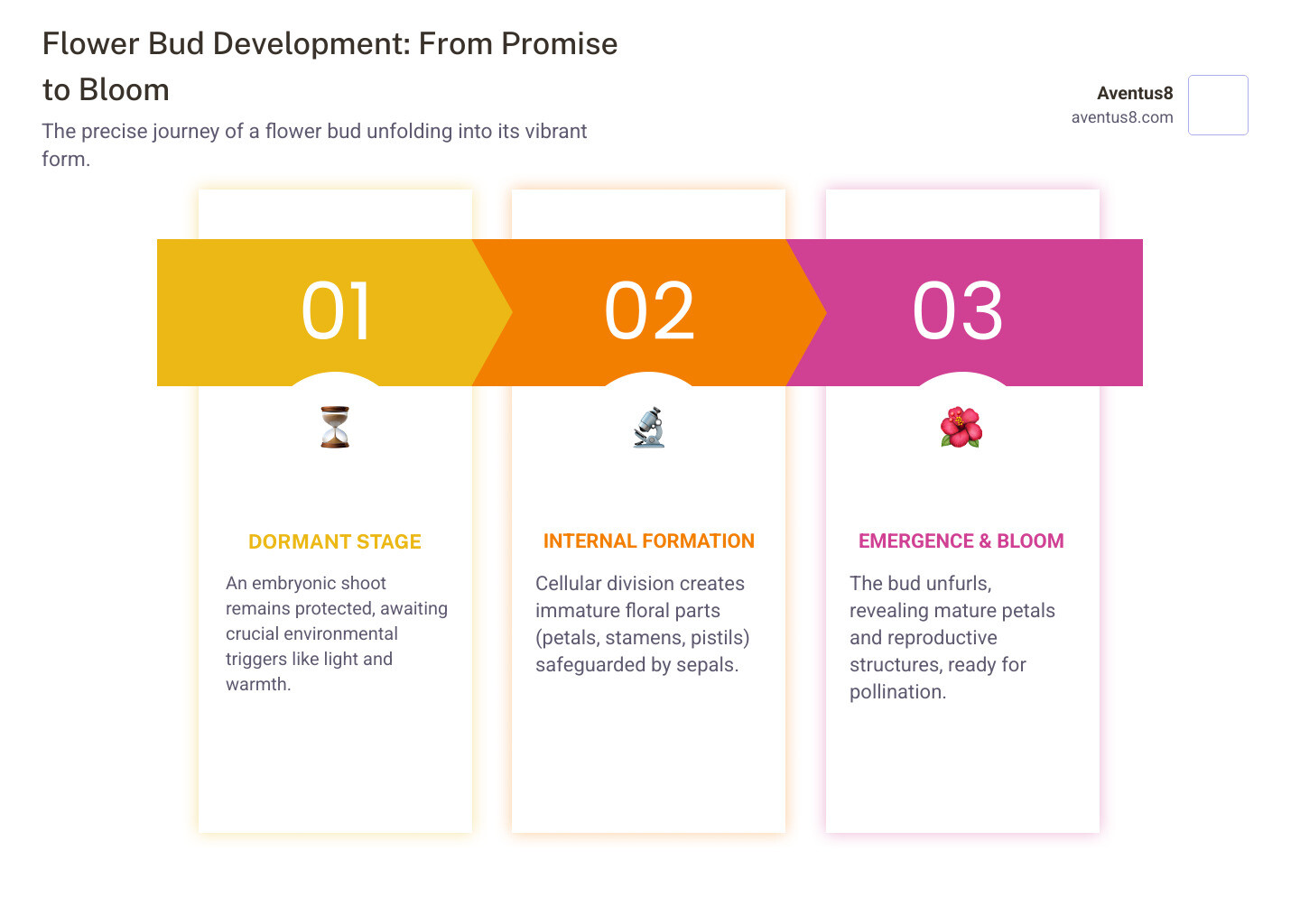
Flower bud development is a precise process starting with bud initiation, happening constantly in the lush gardens of Hollywood, FL. Here, meristem cells are signaled to form floral parts instead of leaves. This cellular division shapes the future flower long before it's visible.
As the bud develops, it undergoes a series of changes:
- Formation of Reproductive Parts: Inside the tiny flower bud, the embryonic petals, stamens (male organs), and pistil (female organ) are formed.
- Protection by Sepals: Before petals emerge, they are protected by sepals. These leaf-like structures form the bud's outermost layer, shielding the interior from damage. You can see these green sepals on a rose or hibiscus in Hollywood, FL.
- Inflorescence Emergence: As the plant matures, often around 26 days after leaf growth begins, we see "inflorescence emergence"—the visible appearance of the flower buds.
While timelines vary, a fast-growing annual in a Hollywood garden might go from seed to bloom in several weeks. Germination in our warm soil often begins within five days, with leaf development following until around day 26, when flower buds appear. These timelines are, of course, influenced by our specific South Florida conditions.
Environmental Cues in the Sunshine State
In South Florida's climate, environmental factors are critical for flower bud development. While our plants don't need cold exposure to break dormancy, they respond keenly to other cues.
- Influence of Light (Photoperiodism): The length of day and night is a major trigger for flowering. Even in sunny Hollywood, FL, subtle changes in day length can signal plants to set buds.
- Impact of Temperature: Our consistently warm South Florida temperatures promote continuous flowering for tropical species. However, extreme heat can stress plants and affect bud formation.
- Water and Nutrients: Proper hydration and nutrition are crucial for healthy flower bud development. In South Florida's climate, with its intense sun and sudden downpours, maintaining consistent moisture without overwatering is key. A plant under stress from either extreme may produce fewer or weaker buds.
- Pruning Techniques: Pruning correctly can encourage more blooms. The Merriam-Webster entry on "flower bud" advises, "Pruning just after plants finish flowering... to ensure the next season's flower buds aren't removed." For many Hollywood shrubs like ixora, timing pruning after a bloom cycle encourages new growth and more flower buds.
Beyond the Garden: The Diverse World of the Flower Bud
Flower buds are significant beyond garden aesthetics. In South Florida, their importance extends from local agriculture to culinary uses, where they are vital for food production and even considered delicacies.

Edible Buds
Many common vegetables are, botanically speaking, buds:
- Cabbage: An exceptionally large terminal bud.
- Brussels Sprouts: Large lateral (axillary) buds.
- Broccoli and Cauliflower: Inflorescence buds, or clusters of undeveloped flower buds.
- Artichokes: The large, unopened flower bud of a thistle plant.
You can find many of these, like broccoli and cauliflower, at local Hollywood farmer's markets, underscoring the agricultural importance of buds as nutritious food sources.
The Unique Cannabis Flower Bud
At Aventus8, our focus is the remarkable cannabis flower bud. The Cannabis Sativa flower is a unique structure, significant for its therapeutic and recreational properties.
The cannabis flower bud marks the female plant's maturity, where it produces a wide array of beneficial compounds. These specialized flowers are rich in:
- Phytocannabinoids: The plant's unique chemical compounds, including THC and CBD, which interact with our body's endocannabinoid system.
- Terpenes and Flavonoids: These aromatic compounds create the plant's distinctive smell and contribute to the overall effects, known as the "entourage effect." As we discuss in our guide, Beyond the Buzz: Everything You Need to Know About Premium Hemp Flower, these are crucial for a premium experience.
In Hollywood, FL, the legality of hemp-derived products (with less than 0.3% Delta-9 THC) allows us to use these flower buds for wellness. Bud development is a complex process influenced by genetics, light, and nutrients, culminating in the rich flowers we value.
What Makes a Premium Bud?
At Aventus8, we know the quality of a cannabis flower bud is paramount. A premium bud results from meticulous cultivation, careful processing, and respect for the plant's potential.
- Indoor vs. Outdoor Cultivation: "Indoor grown hemp flower is superior to outdoor grown hemp due to the ability to control the grow in what amounts to a lab setting." This control leads to a more consistent, higher-quality product, which is why we prioritize it.
- Hand-Trimming: A premium flower bud should be hand-trimmed. This process removes excess leaves and stems, leaving only the dense, trichome-rich flower.
- Curing Process: After harvest, buds are carefully dried and aged. Proper curing improves the flavor, aroma, and potency, leading to a smoother product.
- Aroma and Appearance: A premium flower bud has a rich aroma and vibrant appearance. Look for dense buds with a generous coating of sparkling trichomes—the tiny structures housing cannabinoids and terpenes. As our guide, The Loudest Buds: Where to Find Top Tier THCA Flower Online, explains, these cues indicate a top-tier product.
For us, delivering a premium flower bud means upholding the highest standards from seed to sale for our Hollywood, FL customers.
Frequently Asked Questions about Flower Buds
We often get asked about the intricacies of flower buds, both for ornamental plants and for premium hemp flower. Here are some of the most common questions we hear:
How can I tell the difference between a flower bud and a leaf bud?
Distinguishing between a flower bud and a leaf bud becomes easier with practice. Here are the key identifiers:
- Shape: Flower buds are generally rounder or more swollen. Leaf buds are typically more pointed or slender, designed to unfurl into flat leaves.
- Location: While both can be terminal or axillary, flower buds often appear on specialized flowering stalks or in clusters. The tight clusters on a jasmine vine in Hollywood, FL, are usually flower buds.
- Plant's Flowering Season: Consider the plant's natural flowering cycle. If it's the season for a plant to bloom, any developing plump buds are highly likely to be flower buds.
How long does it take for a flower bud to open?
The time a flower bud takes to open varies greatly by plant species, environmental conditions, and bud maturity.
- Varies by Species: Some annuals have buds that open within days, while some woody plants in our region might take weeks or months to unfurl.
- Environmental Factors: Light, temperature, and water play a significant role. The consistent warmth and sunlight in Hollywood, FL, generally encourage faster development. Extreme weather can slow the process.
- Typical Timelines: From bud emergence to full bloom, the process can range from a few days to several weeks. The initial stages of development can take over a month before the flower bud is even visible, as outlined in "The Stages Of A Flower From Seed To Bloom" research.
Why do some of my flower buds fall off before blooming?
Premature flower bud drop is disheartening but common, often caused by environmental stress:
- Environmental Stress: Sudden changes in temperature (like a rare cold snap in Hollywood, FL), humidity, or light can shock a plant, causing it to shed buds.
- Water Issues: Both overwatering and underwatering can lead to bud drop. In South Florida's climate, with its intense sun and sudden downpours, it's crucial to maintain consistent moisture without waterlogging the roots.
- Nutrient Deficiency: A lack of essential nutrients, particularly phosphorus and potassium, can hinder a plant's ability to support its buds. This is especially true in South Florida's often sandy soil, which may require amending.
- Pest Problems: Small insects like aphids or thrips, which thrive in our warm climate, can damage buds and cause them to fall off. Inspect your Hollywood garden plants regularly for any signs of infestation.
- Pollination Issues: If a plant isn't adequately pollinated, it might drop its buds to conserve energy. Even with the abundance of pollinators in South Florida, this can sometimes occur, especially on days with heavy rain.
Conclusion
The flower bud symbolizes potential, growth, and the cycle of life. We've explored its botanical basics, the diverse types in our Hollywood, FL landscapes, and its life cycle from dormancy to bloom, guided by our climate's environmental cues.
We've also seen the flower bud's role in agriculture and cannabis. At Aventus8, this understanding drives our commitment to quality, ensuring every premium flower bud we offer meets the highest standards.
Whether admiring a bougainvillea bud in your Hollywood backyard or exploring hemp flower, the flower bud reminds us of nature's beauty and utility. We invite you to continue your exploration and find the premium options available.


